All women above 40 years old are encouraged to get a mammogram. Breast cancer, if detected early, can be life-saving. I had this wake-up call when one of my dearest colleagues at the clinic was diagnosed with cancer. In her case, she had a palpable lump, which she went to get it checked out.
As for myself, I do not have a lump. I do not have noticeable changes in my breast or areola either. So far, I have also not heard of any family members or close relatives having breast cancer. But there is a history of colon and renal cancer. I was offered a colonoscopy due to this, but since I am not experiencing any symptoms for now, I am putting that on hold.
Subsidised mammogram through LPPKN
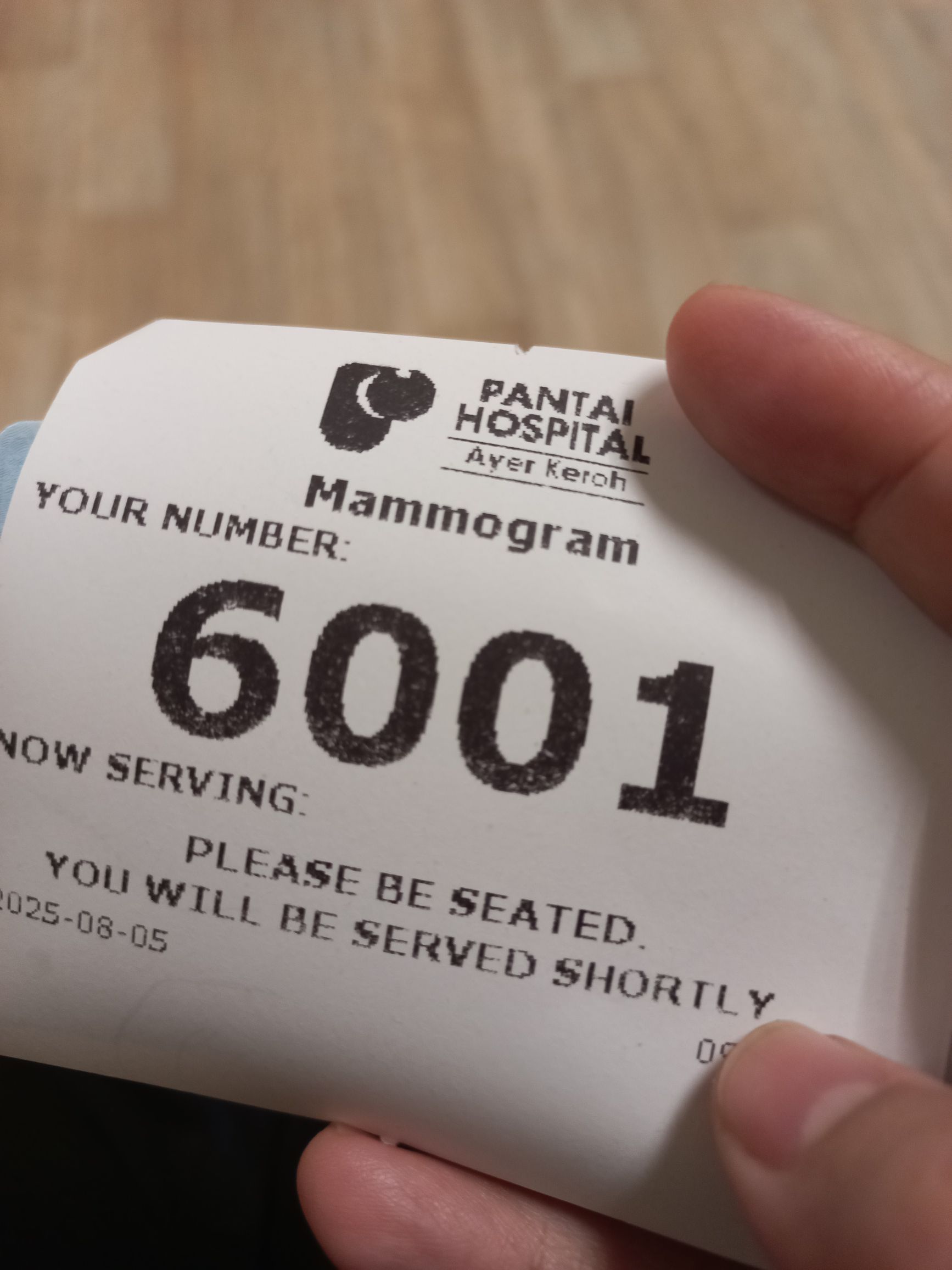
I went to my nearest LPPKN centre. There, I filled up a form and paid RM5 only. I was given a choice to either do my mammogram at Pantai Hospital or Mahkota Medical Centre. In fact, I can choose my own date as well. I opted for Pantai because that’s one of the private hospitals I’ve been to, and I am familiar with the parking area.
There is no need to fast. I can have breakfast as usual. However, refrain from using deodorant, body lotion or talcum powder before the mammogram.
The mammogram service at Pantai has 2 sessions. The morning session was from 9am to 12noon. I chose to do mine on the same day. My turn was quite early, but the reporting took some time. Especially when I had to confirm my findings with an ultrasound. Everything was normal. Perhaps the breast tissue was a bit dense. Or my positioning was bad. The mammogram process did not hurt at all. The radiographer did have to manipulate my arms a bit to get a good view of a certain plane. Otherwise, the procedure was quick. I was done with the imaging in less than 20 minutes, including attire change. My breast was ‘doughed’ and ‘adjusted’ freely by the staff, but well, what has to be done must be done.
Since the mammogram and ultrasound findings are normal, I will only need to repeat the screening in the next 2 or 3 years. However, if I detect a lump on self-breast examination, I should get it checked immediately and be referred to the breast clinic.
I was scrolling Threads today and came across a post from a medical student, asking where would be the best place to do housemanship. Since I’ve only been in Hospital Umum Sarawak (HUS), my answer was obviously Kuching. Personally, I think Kuching is a great place for a Malay from Semenanjung to work because, despite the cultural shock bound to happen, it should be less intense if you’ve been born and bred in Semenanjung for a while. My husband was from Melaka and he did very well in his housemanship. I ended up marrying him and following him to Melaka. Ha ha ha.
If you are a Malay, working in HUS will force you to learn and adjust on how to work with bosses and seniors who are majority, non-Malay. We do not have as many Sarawakians to cover the whole state in the healthcare industry, especially in the medical role of doctors. The vibe is different. The language you use with the patients is also different. Your interaction with your colleagues would also be enriched as you struggle together to get the job done. Is the workplace environment toxic? If toxic is defined as your welfare not being taken off. The answer is a definite yes. In fact, no matter which hospital you go to, toxicity is part of the training. Like it or not it happens. Mind you, I do not condone bullying or ‘during my time’ gloating sort of thing, but it is inevitable.
However, it is what you get out of the housemanship period
the empathy towards our fellow Malaysians upon realising that we still have a long way to go in empowering healthcare literacy among patients and the community as a whole
Malay supremacy means nothing in this part of the state
racism exists but tolerance is a must to live in harmony. Raya, Christmas, Gawai and Chinese New Year is so meriah here. Deepavali not so much because there’s not many Indians but it is still celebrated by them on a smaller scale.
housemanship is hard everywhere but being in Kuching gives you that unique experience when it comes to the people and the natural beauty of the state. Do visit it’s local islands, caves etc. As for the people, they are the true embodiment of Bangsa Sarawak. You couldn’t tell if they were Iban ka, Malay ka,or Melanau ka. It kind of reminds you of Indonesia. They talk in the same language and turns out to be of Chinese ethnicity and all. The only difference is we are not compelled to have Indonesian names like they do in Indonesia. So you could still guess their ethnicity. And did I tell you Sarawakians talk so soft and gentle? They have a beautiful rhythm to their speech.
if you’re Muslim, you would InsyaAllah become a better Muslim as you would be creative in thinking how, when and where to perform your prayers. Be extra vigilant in choosing places to eat or cooking your own stuff. Cause honestly the nasi paprik I bought in Kuching tasted weird. Halal eateries are easily available in certain areas only. Otherwise, you would need to check with the local website. Ha ha. But the local dishes are to die for.
What if you are a non-Malay or non-Bumi? I would recommend Kelantan. Don’t worry. You wouldn’t be Islam tiba-tiba. Somehow I think the locals would adore you and want to give you their best hospitality. That is what I THINK. PLEASE DO NOT TAKE IN EVERY WORD OF IT. The dialect will be challenging but just like in Kuching, it is nice to see everyone of all ethnics talking in Kelantan. I am saying this because I used to have a Chinese colleague coming from Kelantan. Talking to him in Malay with a tinge of Kelantan accent sounds so cute. He could speak Chinese too.
Housemanship is intense. You will feel stupid. Your feet will swell. You will feel that you want to quit or die. But just hang on. Pray. Doa. The hardship will pass and you will reminisce on the good times. Entah2 jumpa pasangan hidup. Macam tu lah.
My daughter’s chicken pox came without a warning. It just erupted on one fine day without her getting a fever. I should have taken note when she mentioned that a few of her friends were off from school because they had chickenpox.
I was picking her up from daycare as usual in the evening after work. Suddenly the teachers stopped in their tracks as they sent my daughter out to the gate. They appeared concerned as they looked at her face. I thought she had another episode of epistaxis. Then one of the teachers brought her to me quickly and said, “We just noticed this on her face but she was well today”. A quick glance showed several vesicles on her face. It was undoubtedly chickenpox. I reassured the teachers that it was okay, she is bound to get it one day and that I was actually glad she caught it now. At least I don’t have to worry about it once she gets into formal schooling.
I messaged my husband to bring back some calamine lotion from his place of work. If I knew earlier, I would have written a prescription at my own clinic. I brought her to see the doctor at a nearby clinic the next day as my own place was closed on Saturday. The reason being I wanted to collect a letter to certify that my daughter has chickenpox and that I needed a few days’ leave of absence to take care of her. It was a straightforward process and we were done in less than an hour. I then informed my superior via phone regarding the leave and uploaded the form onto HRMIS. It was also my first time downloading my e-GL from HRMIS for that clinic visit. Things are so easy nowadays with the technology that we have.
My daughter is well with a low-grade fever. The vesicles are coming out very fast and drying up just as quick. Her appetite remained normal although I do have to remind her from time to time to keep hydrated. One thing that is giving me a headache in the morning is that she wakes up at 2am asking for cookies and a glass of water. It is usually very hard for me to go back to sleep after that. Anyway, there is always a silver lining to the cloud. At least I get to polish my assignments and do my revisions for this exam month peacefully for the next few days.
An ex-colleague of mine, NS, just lost her beloved father to Covid-19 last week. I worked with NS briefly at a district hospital many years ago in the emergency unit. She left the unit for a dream to become an independent private medical practitioner on top of family commitments. Years passed. She did very well and from what I witnessed from afar, she has come to a stage that she is renowned as a local celebrity. The one with alhamdulilah, positive influence.
The challenges of becoming this public figure however comes with a price. Everything about her life and actions were scrutinized by netizens. I was so saddened to see how some of these people, who were not even there, were passing judgments on how she, a doctor, should manage her father’s condition. They screenshot her pictures and videos with her father and made it an ‘illustration’ to their own blog/ face book post about a topic that they want to talk about.
Netizen Comments
There was a comment on Habbatus Sauda (black seed), an alternative superfood that boasts a multitude of benefits. They were saying that because she is a doctor, this form of therapy was probably not put forth to her father causing him to succumb to his premature death. Then there were so called opinions that to put the father on a ventilator in ICU was a terrible idea because he looked fine! And that it was the ventilator that sped up his death. All these were said at the time when NS and her family was grieving. Some may say, just ignore it. However, in Malaysia, this is a big deal as social media is a heavily ingrained neo-culture in our everyday lives. I think we are like the top 5 users of social media in the world? Having someone posting on social media bad things about you is like having that person standing right next to you during the funeral. You could literally trigger someone to respond with just a few words on social media.
I have nothing against Habbatus Sauda. It has its benefits but like any form of food, it does have it’s limitations and you don’t treat something that needs a quick fix by consuming Habbatus Sauda while hoping that everything will be alright in a few minutes. We have to be realistic. What I am really bugged about is how people perceive the use of ICU care.
Who gets to go to Intensive Care Unit
ICU care is not for patients who, from the anaesthetists assessments are candidates heading towards imminent death. That is palliative care.
ICU is for those who are very ill but having the chance to pull it through and survive. We do have patients who are not ventilated in ICU because we anticipate a problem that could happen if the patient is managed in a normal ward and not monitored by the hour. For example, a patient with a long bone fracture. He may be alert and sitting up but he is at risk of a fat embolism from his injury. If his vitals are not monitored regularly, the early symptoms may be missed. Being on a ventilator per se is not an automatic ticket for a place in ICU. A patient could be ventilated in the wards for the comfort of the patient, to help the patient breath but they are not indicated for ICU care. The decision to intubate a patient is never an easy task. This is because it comes with its own risk and complication. But once a decision is made, they are always in the patients best of interest. Tak adalah orang suka2 nak masuk tube dan menyusahkan pesakit . Intubation requires preparation and a lot of planning regarding the patients care , the moment the team makes the step. It looks macam senang to the public when in fact, it is because the team are experienced and have been doing it for a long time.
How is ICU different from managements in the ward?
An ideal ICU set up is when you have 1 nurse caring for 1 patient. We are stretching these skilled nurses to a point of having 1 nurse caring for probably 3 patients. This nurse will be responsible to check on the patient from head to toe. From simple hygiene to matters as heavy as flow of inotropes and fluid. Every single input and output of the patient is measured. Apart from carrying out the doctor’s order, they are the eyes and ears that identify the turning point of the patient of whether they are getting better or worse. Every beep from the machines carry a different meaning and if a skilled person has worked in ICU for a long time, even the slight change in the beep tone was enough to warrant a concern from the nursing side. The problem will be highlighted to the intensivists for review and managed accordingly.
When I was a medical officer in the surgical department, one of the surgeons was very keen to learn the trick of the trade in managing pancreatitis. He wanted to lessen the burden on ICU by trying to manage his these patients in the general ward. He wanted to know what is ICU doing differently there so that he could emulate and bring on the practice in his ward. I never knew what was the final answer but I guess the strength of ICU lies in paying attention to the most meticulous detail in patient management. The drips per hour, the difference in pulse pressure, body temperature etc.
NS’s father was a suitable candidate for ICU. I cannot see it as otherwise. He had a chance to survive but the impact of Covid-19 was greater. I could only pray that NS and her family forgive those who perceived his care pathway as detrimental to his condition. That they could grieve in peace and move forward as a family.
I am taking Akurit-2 & Pyridoxine. My regime will be completed by the end of next week at Day 90.
I experienced mild nausea during the first few days on the meds. It reminds me of the bad morning sickness I had in my 2nd pregnancy. My urine did turn a hue of red and orange in the immediate 2-3 hours after swallowing the pills. Initially, I had thought that it would take me a few days to develop that sign. I also had horrible flu-like symptoms which is unpleasant to have during this pandemic. Coincidentally we had staff screening at the clinic that same week using the RTK-Antigen. I tested NEGATIVE for Covid-19.
I noticed I had nightmares too in the first week. I had horrible dreams of Covid-19, dengue fever and other weird disease management. Not sure if it is an after-effect of stress at work or the meds. I did not have insomnia. Instead, I have terrible somnolence. It was as bad as taking Actifed for my occasional runny nose. I did not experience major peripheral neuropathy (so far). My liver function was monitored at 2 weeks and 2 months after starting the treatment. So far, it has been normal.
The paramedic in-charge of my regime allowed me to bring home 2 weeks supply of the medicine. I don’t have to take it at the same time everyday but it would be helpful to stick to one. Akurit-2 is best taken on an empty stomach for better absorption unlike pyridoxine where you can take it at anytime you want. Obviously, I take them together.
I have had people asking me if this would KILL ALL THE TB BACTERIA in my body.
The thing is, Medicine is never 100% guaranteed. There is always a small percentage of patients that will still have active TB one day. On my part, I am doing this for myself, my family and the people around me. I also took my Pfizer vaccine shot whilst on the treatment. I did not experience any major side effects from being on the regime and taking the vaccine. Yes, I did have malaise and a mild fever 24 hours after the 2nd dose of Pfizer but that’s it. Now I feel fine.
Cost of treatment for latent TB
As a Malaysian citizen, I only need to pay RM1 for registration and for every visits to see my attending doctor. I have had two visits. That means on top of the initial RM1, I am paying another RM2. My blood works are FREE. My consultation fee is FREE. My medicine is FREE.
 Minci Moss